

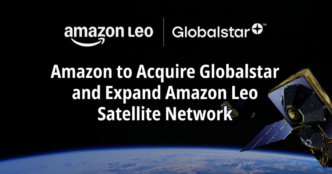
Why it matters: Amazon is not just buying a satellite operator. It is buying spectrum, operational know-how, and an existing Apple-facing service layer that could accelerate its move from broadband-only LEO ambitions into direct-to-device connectivity. Amazon says the deal will bring Globalstar’s satellite operations, infrastructure, and MSS spectrum licenses into Amazon Leo, while a parallel Apple agreement makes Amazon Leo the long-term platform for current and future satellite features on supported iPhone and Apple Watch models.
Amazon Leo, formerly Project Kuiper, has so far been positioned primarily as a low Earth orbit broadband network. This announcement changes the frame. Amazon now says Leo’s future architecture will include a dedicated D2D layer for voice, messaging, and data, aimed at helping mobile operators extend service beyond terrestrial coverage.
By the numbers:
- Amazon Leo is built around an initial constellation of more than 3,000 LEO satellites.
- Amazon says its next-generation D2D system will begin deploying in 2028.
- Globalstar’s Band 53/n53 is authorized or licensable for private wireless in 11 countries, and Qualcomm added n53 support to its X65 modem, which matters for device ecosystem relevance beyond satellite-only services.
- The transaction is expected to close in 2027, subject to regulatory approvals and satellite milestone conditions.
Between the lines: The real strategic asset here may be less about satellites alone, and more about controlled spectrum plus an already-deployed service relationship. Apple’s current satellite features already rely on Globalstar’s network, and Apple lists Emergency SOS, Messages, Find My, and Roadside Assistance among the supported off-grid services on iPhone 14 and later. That means Amazon is not entering the consumer satellite space from zero. It is stepping into a working service footprint with existing devices, software flows, and user expectations.
The bigger picture: For operators, the pitch is straightforward: satellite is becoming a coverage extension layer, not just an emergency fallback. Amazon says the Leo D2D system will integrate with its first- and second-generation broadband systems, creating a combined fixed-and-mobile architecture rather than a standalone direct-to-cell overlay. That points to a broader market shift in which hybrid terrestrial and non-terrestrial networks become part of the mainstream connectivity stack.
There is also a spectrum story here. Globalstar brings globally authorized MSS assets and a terrestrial Band 53/n53 position that has already been pushed into the 5G device ecosystem. In practical terms, Amazon is acquiring not just orbital capacity, but regulatory leverage and optionality across both satellite and terrestrial domains. That is likely to matter as D2D competition moves from emergency messaging toward broader voice, data, enterprise, and government use cases.
What to watch: First, whether regulators clear the transaction on the timeline Amazon expects. Second, whether Amazon can turn the Apple agreement into a broader roster of MNO partnerships. Third, how quickly Leo’s 2028 D2D roadmap translates into commercial services that are meaningfully faster or more capable than today’s more limited satellite messaging models. Amazon is explicitly promising higher spectrum efficiency, tighter integration with its wider Leo system, and support for hundreds of millions of endpoints over time.
Bottom line: This is one of the clearest signs yet that D2D is moving from niche safety feature to strategic network layer. Amazon is using the Globalstar deal to buy time, spectrum, and distribution all at once, and that makes the NTN race more consequential for operators, device makers, and the broader 6G ecosystem.