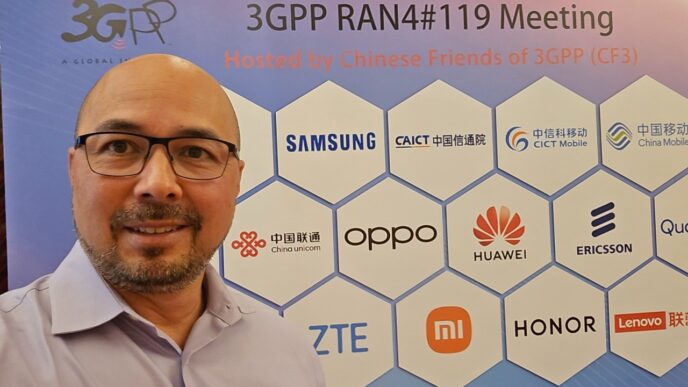




In an interview with Peter Pietrzyk, Managing Director of 6GWorld, Patrick Savelli, Head of Connectivity at b-com, explained why platforms such as Open XG Hub could become increasingly important as the industry moves toward more open, software-driven, and AI-native networks. The broader message is clear: one of telecom’s biggest challenges is no longer just inventing new ideas, but validating, integrating, and operationalizing them in realistic environments.
Telecom has never lacked promising ideas. What it has often lacked is a practical path from experimentation to real deployment.
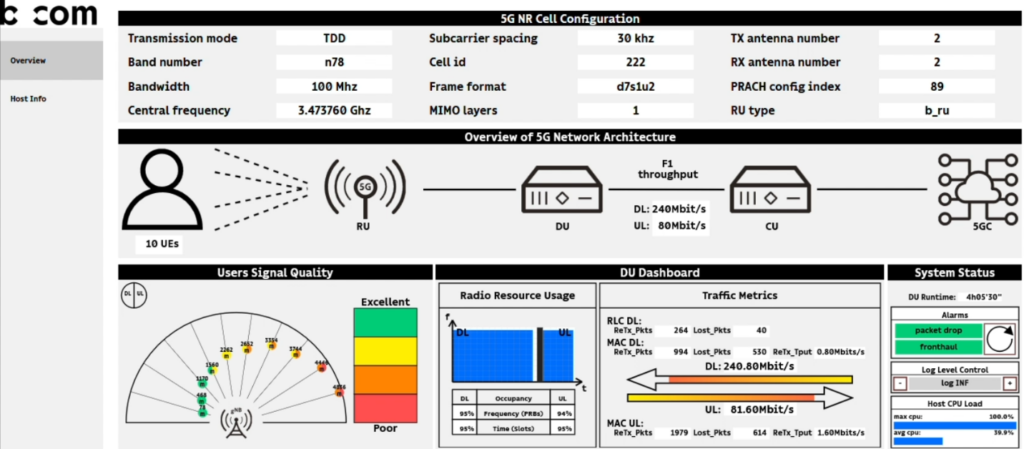
That is the gap b-com says it is trying to address with Open XG Hub, its end-to-end experimentation platform for 5G and future 6G networks. In my interview with Patrick Savelli, Head of Connectivity at b-com, he described the platform as a bridge between advanced research and real-world industrial validation, giving partners a way to test architectures, applications, and integration models before committing to large-scale deployment.
Savelli sees organizations like b-com as playing a specific role in the ecosystem: helping move innovation from academic research into practical industry use. In his view, that means reducing risk, accelerating collaboration, and creating environments where new concepts can be evaluated under more realistic conditions.
That role is becoming more important as wireless systems become more complex. Savelli pointed out that many existing test environments tend to fall into one of two camps. On one side are academic testbeds that are valuable for research but difficult to translate into operational networks. On the other are proprietary vendor environments that may be closer to real deployment but are often less open and less flexible for broader experimentation. Open XG Hub, he suggested, was built to sit between those two worlds.
Why it matters
The telecom industry talks constantly about open architectures, AI-native networks, private networks, non-terrestrial integration, and future 6G systems. But turning those ideas into deployable networks remains difficult.
Savelli’s view is that the barriers are not purely technical. Interoperability, regulation, business incentives, operational readiness, and the challenge of proving value at scale all play a role. Even when a concept works in a controlled setting, that does not mean it is ready for production. Operators still need confidence that it can perform reliably, comply with requirements, and support a viable business case.
That is where experimentation platforms can matter more than many assume. They do not remove uncertainty, but they can surface it earlier. In practice, that means helping partners identify integration problems, performance bottlenecks, and architectural trade-offs before they become expensive deployment issues.
What Open XG Hub is trying to do
Savelli described Open XG Hub as a flexible experimentation environment spanning RAN, core, and multiple frequency bands, combining open-source building blocks with b-com’s own software developments. The intention is to support both research activity and more realistic industrial testing in the same environment.
That opens the door to a broad set of activities, including experimentation around AI-native communications, non-terrestrial networks, low-latency industrial networking, advanced waveforms, and joint sensing and communications. Just as importantly, it provides a platform where partners can test modules, validate interoperability, and explore new architectures without needing to move immediately into full deployment.
For b-com, the platform is also part of a wider positioning effort. Savelli made clear that the goal is not only to showcase technical capability, but also to strengthen b-com’s role as a meaningful player in the broader ecosystem connecting research, innovation, and industry collaboration.
Open architectures still come with a cost
Savelli does not frame open platforms as a cure-all. He acknowledges a reality that many operators continue to raise: open architectures may enable greater flexibility and innovation, but they can also increase integration complexity.
That is one of the more useful distinctions in his argument. Open platforms do not necessarily make networks simpler. What they can do is move complexity into a more controlled environment, where it can be studied, tested, and addressed before it affects production systems.
That shift matters. In a traditional closed model, many integration issues remain hidden until late in the process. In a more open and experimental model, those challenges may appear earlier, but that early visibility can itself be a strategic advantage. In Savelli’s framing, the point is not to pretend complexity disappears. It is to make experimentation realistic enough that complexity can be managed more intelligently.

Private networks show both the promise and the problem
Private networks remain one of the clearest examples of this tension.
Savelli sees private networks as valuable environments for innovation because they offer controlled settings where enterprises, industrial players, and researchers can test advanced architectures and new applications in real-world conditions. They can support customization, edge integration, low latency, and targeted performance in ways that public networks often cannot.
At the same time, he is clear-eyed about the economic challenge. Many private network deployments remain small, highly customized, and difficult to scale profitably. That creates a persistent tension between experimentation and commercial viability.
The more tailored and innovative a private network becomes, the harder it may be to replicate economically across many sites. But moving too far toward standardization can reduce the flexibility that makes these environments useful for experimentation in the first place.
Savelli pointed to a few possible ways the industry may try to close that gap, including shared infrastructure models, Network-as-a-Service approaches, modular deployment strategies, and public support mechanisms. Even so, the broader business challenge remains unresolved.
AI-native networking raises the bar for experimentation
One of the most important parts of the discussion was Savelli’s view on AI-driven networks.
He argued that traditional telecom test environments were not built for systems whose behavior changes over time. AI-native networks introduce a different kind of challenge: instead of validating mostly static behavior, the industry increasingly needs to validate systems that adapt, optimize, and make decisions dynamically.
That raises new requirements around continuous monitoring, scenario-based testing, repeatability, explainability, and debugging. It is no longer enough to verify that a network behaves correctly under a fixed set of conditions. The harder problem is understanding how AI-driven systems behave under changing loads, evolving conditions, and real-world operational stress.
In that context, platforms like Open XG Hub may become more valuable. Savelli’s point is that open, modular, end-to-end environments can give the industry a safer place to test AI models and control loops across RAN, core, and edge, before exposing them to live production networks.
The real bottleneck may be software integration
Savelli’s broader message is that telecom innovation is becoming increasingly constrained not by a lack of radio or hardware progress, but by the growing complexity of the software layer.
Hardware continues to improve. Radios, chipsets, accelerators, and spectrum technologies are all advancing. But software architecture, orchestration, and integration are evolving even faster, driven by cloud-native design, virtualization, containerized functions, open interfaces, and AI-based control.
That makes integration the real challenge. Even when individual components are technically strong, combining them into a stable, scalable, and carrier-grade system remains difficult. In Savelli’s view, that is precisely why experimentation platforms matter. They create a place where those integration challenges can be exposed before they become operational failures.
The bigger picture
The industry often talks about 6G in terms of breakthrough technologies, future capabilities, and next-generation use cases. Savelli’s perspective is a useful reminder that the path to those outcomes may depend just as much on the environments used to validate them.
If his view is right, the next phase of telecom innovation will not be defined only by who has the best ideas. It will also be shaped by who can provide credible platforms to test, integrate, and operationalize those ideas under realistic conditions.
That makes experimentation infrastructure more strategic than it might first appear. In a market moving toward open, software-defined, and AI-native systems, the ability to bridge research and deployment may become one of the most important capabilities of all.
To learn more about the broader initiative, this work ties directly into b<>com’s Open XG Hub, a platform designed to close one of telecom’s biggest gaps: moving from experimentation to deployment.