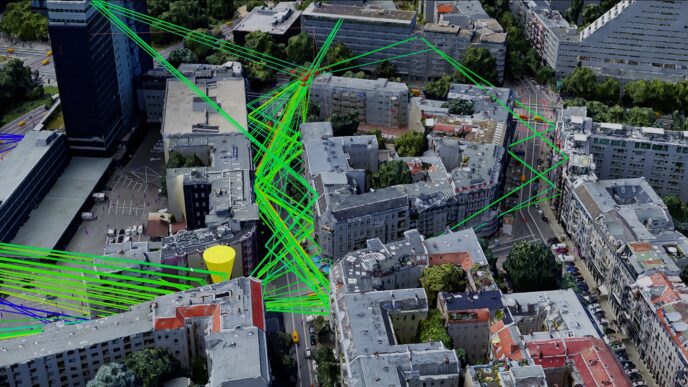




RF Digital Twins: Why 5G-Advanced and 6G Need Predictive Simulation
As wireless systems become more tightly coupled across RF, antenna, baseband, and channel domains, simulation must move closer to predictive validation.
Produced in partnership with Keysight Technologies
The conversation around 6G often starts with ambition: higher data rates, lower latency, new spectrum, integrated sensing, AI-native operation, and tighter terrestrial and non-terrestrial integration. Those ambitions matter. But they also create a harder engineering question that receives less public attention.
Can next-generation wireless systems be modeled realistically enough before hardware is built?
That question is becoming more important as 5G-Advanced evolves and early 6G research moves closer to system design. The problem is no longer just whether a waveform, antenna concept, RF architecture, or algorithm performs well in isolation. The problem is whether the complete system still performs as expected once RF impairments, phased-array behavior, propagation conditions, mobility, channel dynamics, and implementation constraints interact.
That is where the industry’s simulation challenge is changing.
For previous generations of wireless technology, many design workflows could still be separated by domain. RF engineers modeled amplifiers, mixers, oscillators, filters, and spectral behavior. Antenna teams worked on array geometry, radiation patterns, and beamforming. Baseband teams evaluated algorithms against channel assumptions. Test teams later measured performance against physical hardware.
That separation is becoming less defensible.
In 5G-Advanced and 6G, system performance is increasingly shaped by coupled effects across RF, antenna, baseband, and channel domains. A nonlinear power amplifier can influence EVM, spectral emissions, and energy efficiency. Phase noise, I/Q imbalance, frequency offsets, memory effects, and sampling jitter can interact with wideband waveforms. Beamforming quantization, calibration errors, and active impedance can affect coverage and link reliability. Doppler, fading, delay, atmospheric attenuation, and mobility can reshape performance in terrestrial and non-terrestrial scenarios.
Individually, many of these effects are familiar. In combination, they create system-level behavior that is much harder to predict.
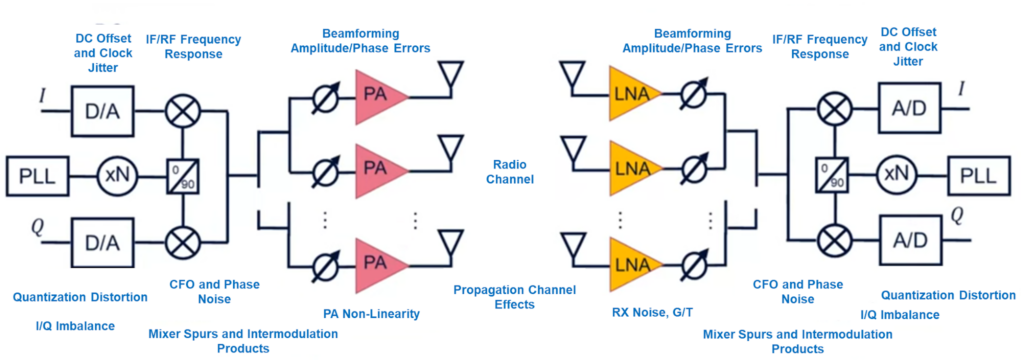
5G-Advanced and 6G system performance is increasingly governed by the interaction between RF impairments, antenna behavior, beamforming, channel effects, and validation workflows.
The issue is not only complexity. It is coupling.
Wireless system design has always involved complexity. Engineers have always balanced performance, cost, power, bandwidth, coverage, device constraints, and implementation risk. What is changing now is the degree of coupling between those trade-offs.
A phased-array system is a useful example. In an ideal model, beamforming can be treated as a matter of array geometry, weights, and steering direction. In a real system, the beam shape also depends on RF chain behavior, amplifier nonlinearity, phase and amplitude errors, active impedance, thermal effects, calibration, and channel conditions. The useful output is not an isolated antenna pattern. It is the performance of the complete signal chain under realistic constraints.
The same pattern appears in non-terrestrial networks. NTN design cannot be reduced to a clean link budget. A realistic model must account for satellite motion effects through parameterized or externally generated models, large propagation delays, Doppler shifts, feeder and service links, gateway behavior, payload architecture, user terminal RF performance, antenna arrays, and dynamic channel effects.
Integrated sensing and communication introduces another layer of coupling. In ISAC, the same waveform and hardware infrastructure may be used for both data transmission and environmental sensing. That creates a different KPI problem. Throughput, EVM, and SINR are not enough. Sensing accuracy, range resolution, velocity estimation, angle detection, clutter behavior, and target classification also matter.
Reconfigurable Intelligent Surfaces create still another modeling challenge. RIS-assisted links depend on phase and amplitude control, quantization, reflection behavior, channel interaction, beam steering, surface design, and practical hardware constraints. Again, an ideal model may be useful for exploration, but it is not enough for validation.
This is the methodological burden of next-generation wireless design. The important question is no longer only, “Does this block work?” It is, “Does the system still work when the real constraints are included?”
Why idealized simulation is not enough
Idealized models are still useful. They help researchers explore concepts, compare candidate approaches, and reduce early complexity. But they become dangerous when treated as evidence of deployment-ready performance.
The gap between ideal simulation and physical behavior can appear in many places.
A waveform may show attractive performance under clean channel assumptions, but become less compelling once PA behavior, spectral emissions, and implementation complexity are included. A beamforming design may look strong in an antenna-only model, but degrade when RF impairments, calibration, or active impedance are considered. An NTN architecture may appear viable in a simplified analysis, but become more fragile once Doppler, delay, satellite motion, atmospheric effects, and terminal constraints are modeled together. An ISAC concept may work in principle, but fail to meet both communication and sensing requirements under realistic RF impairments.
This is why the value of simulation is shifting. Simulation is no longer only a way to evaluate ideas. It is becoming a way to build confidence before hardware implementation.
That requires simulation environments to become more predictive, more measurement-aware, and more closely connected to validation.
What makes an RF Digital Twin different?
The term “digital twin” is used widely, sometimes too widely. In RF and antenna system design, it needs a practical definition.
An RF Digital Twin should not be a static drawing of a wireless system. In practice, an RF Digital Twin is implemented across a connected workflow, with SystemVue acting as the system-level simulation backbone. It should be a high-fidelity, executable, measurement-aligned representation of the system that helps engineers predict real-world behavior before hardware is deployed.
That means an RF Digital Twin must connect several domains in one workflow.
Phased-array behavior is typically represented using imported EM-derived or reduced-order antenna models. It needs to model baseband waveforms, RF impairments, phased-array antennas, propagation effects, and system-level KPIs together. It needs to represent nonlinear RF behavior, phase noise, I/Q imbalance, frequency offsets, memory effects, beamforming errors, and spectral compliance. It needs to support realistic channel conditions, including fading, interference, mobility, Doppler, atmospheric losses, and delay. It needs to allow correlation with lab measurements through measurement-informed behavioral model. It also needs to scale, because next-generation wireless design involves large parameter spaces, multiple operating conditions, and many interacting variables.
In other words, the twin is only useful if it is predictive.
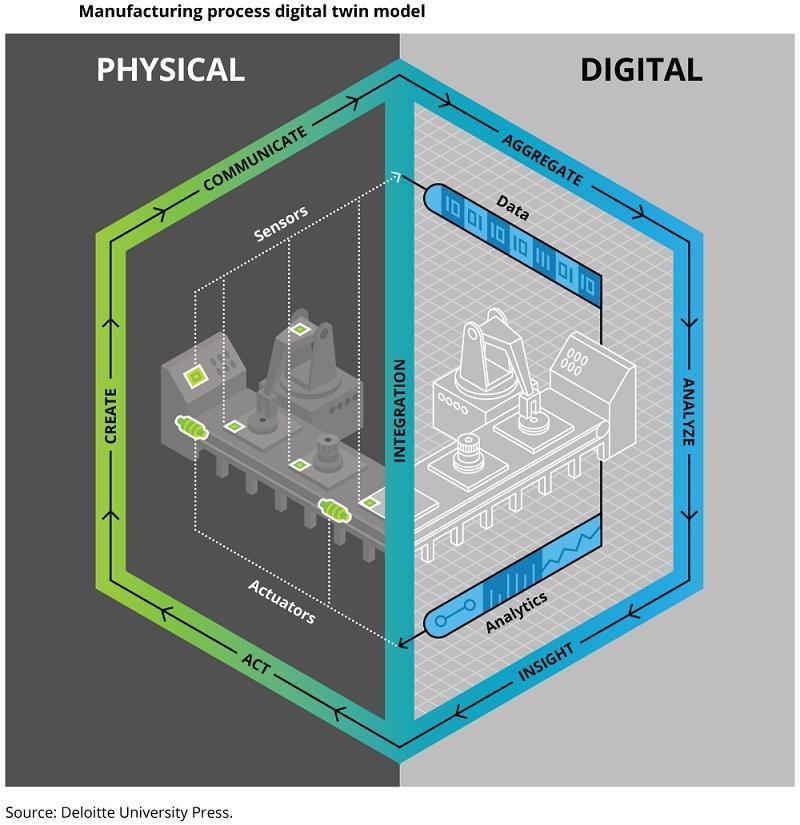
An RF Digital Twin should be physically realistic, cross-domain, measurement-anchored, scalable, and capable of supporting predictive validation before hardware deployment.
This is where RF Digital Twins become more than a simulation label. They become part of a simulation-to-test workflow.
Engineers can model the complete signal chain, incorporate measurement-based device models, simulate realistic environments, correlate results with hardware, and perform parameter sweeps before committing to implementation choices within a system-level environment such as SystemVue, integrated with EM, channel, and measurement tools. The result is not certainty. Wireless systems are too complex for certainty. But it creates a stronger basis for engineering decisions.
Predictive validation changes the design process
The practical value of RF Digital Twins is early risk reduction.
Late-stage design failures are expensive. A problem discovered during early modeling may require a change in parameters, architecture, calibration, or algorithm design. The same problem discovered after hardware implementation can trigger redesign, revalidation, lab delays, field issues, and missed market windows.
Predictive validation helps move more of that learning earlier.
It allows teams to ask harder questions before hardware is built:
- How much PA nonlinearity can the system tolerate before EVM or spectral compliance becomes unacceptable?
- How do beamforming errors affect coverage, link margin, or sidelobe behavior?
- How does Doppler influence waveform performance in a LEO satellite scenario?
- How do RF impairments affect sensing accuracy in an ISAC system?
- How do phase quantization and reflection losses influence RIS-assisted beam steering?
- How does measured hardware behavior change the assumptions used in the system model?
These are not abstract questions. They determine whether a design remains credible when real engineering constraints are applied.
The shift is clear: realistic modeling and simulation are becoming critical because next-generation systems must account for nonlinearities, interference, channel dynamics, hardware impairments, and cross-domain behavior that can significantly affect performance.
NTN shows why the full system matters
Non-terrestrial networks are one of the clearest examples of why RF Digital Twins matter.
As satellite and terrestrial networks become more integrated, NTN design must account for effects that are not central to conventional terrestrial modeling. These include large and variable propagation delays, significant Doppler shifts, satellite trajectory dynamics, atmospheric attenuation, rain fade, shadowing, polarization effects, and intermittent link availability.
But the challenge is not only the channel. NTN also requires realistic modeling of gateway, payload, and user terminal RF chains. It involves antenna arrays, feeder links, service links, nonlinear RF behavior, waveform degradation, EVM analysis, and link robustness under dynamic operating conditions.
A simplified NTN model may support early exploration. But validation requires the ability to connect RF processing, payload behavior, antenna arrays, propagation effects, and KPI monitoring in one environment.
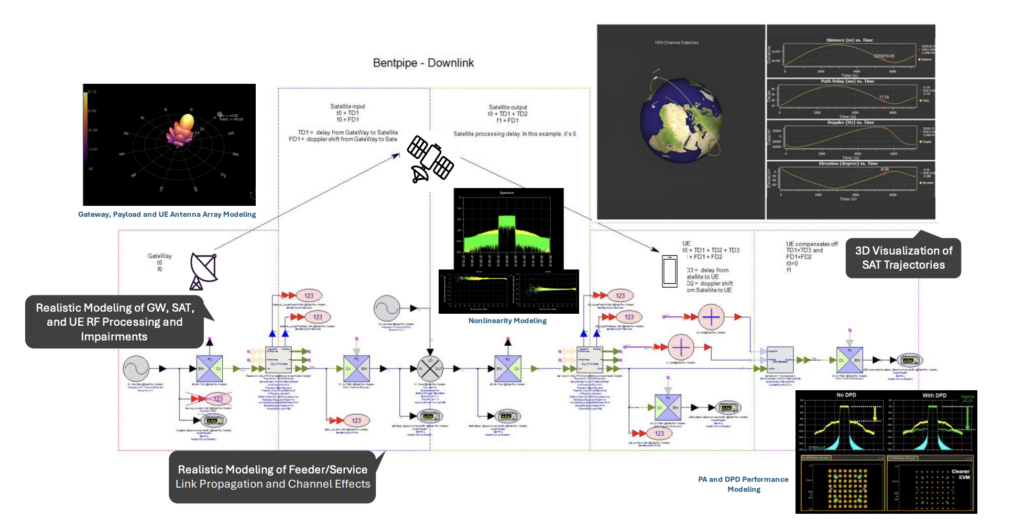
NTN validation requires end-to-end modeling across gateway, satellite payload, user terminal, antenna arrays, RF impairments, propagation effects, and system KPIs.
This is important because NTN is no longer only a specialized satellite topic. In 5G-Advanced and 6G, terrestrial and non-terrestrial continuity is becoming part of the broader connectivity architecture. That makes NTN-aware modeling a mainstream design requirement, not a side case.
ISAC creates a different KPI problem
Integrated sensing and communication creates a different but equally important simulation challenge.
In ISAC, a wireless system may reuse waveform resources and RF hardware for both communications and sensing. That is attractive because it can allow networks to become more aware of their physical environment. But it also means that design validation must account for two different performance domains.
A communication link may be judged by throughput, latency, spectral efficiency, EVM, SINR, or reliability. A sensing function may be judged by detection probability, range resolution, Doppler estimation, velocity accuracy, angle estimation, clutter handling, and target classification.
The same RF impairments can affect both domains in different ways.
Phase noise, I/Q mismatch, antenna distortion, sampling jitter, nonlinearities, full-duplex interference, and multipath propagation can degrade communications performance while also changing sensing accuracy. A model that is good enough for communications may not be good enough for sensing. A model that is good enough for sensing may not support advanced communication waveforms and system-level KPIs.
That is why ISAC reinforces the need for a unified modeling environment. The system must be evaluated as a combined RF, waveform, channel, and signal processing problem.
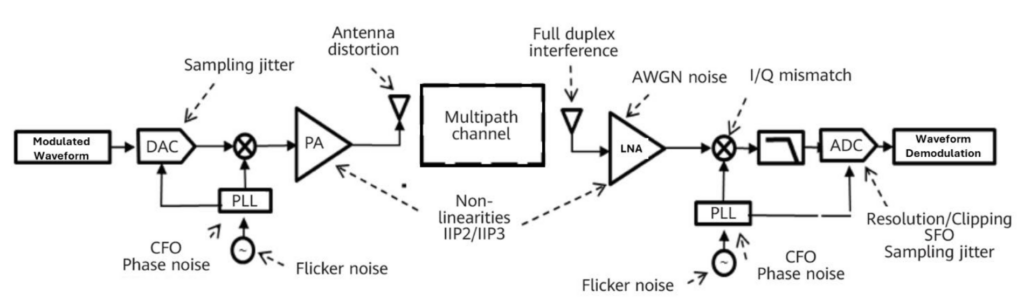
ISAC validation requires engineers to evaluate communications and sensing KPIs under realistic RF impairment and channel conditions.
The key point is not that ISAC can be simulated in principle. The key point is that ISAC must be simulated under the non-ideal conditions that determine whether the concept remains useful in practice.
RIS and phased arrays make propagation part of the design
Reconfigurable Intelligent Surfaces and advanced phased arrays highlight another shift: propagation itself is becoming more designable, but also harder to validate.
RIS promises to manipulate the wireless environment by controlling how surfaces reflect, steer, or shape radio waves. This can help address coverage holes, non-line-of-sight conditions, signal blockage, and energy efficiency. But real RIS behavior depends on the design and control of the surface, phase and amplitude quantization, element behavior, reflection losses, channel conditions, and interaction with the transmit and receive chains.
Similarly, phased-array systems must be evaluated beyond ideal beam plots. Beam shape, EIRP, sidelobe levels, calibration, active impedance, transceiver impairments, and propagation conditions all influence useful performance.
In both cases, the important design question is not whether a beam can be formed in an ideal model. It is whether the intended beam behavior remains credible when hardware and channel constraints are applied.
This is a good example of why RF Digital Twins are useful. They allow engineering teams to evaluate not only the theoretical promise of programmable propagation, but also the practical trade-offs that determine whether the system can be implemented reliably.
Simulation and measurement are moving closer together
The broader shift is that simulation and measurement can no longer be treated as separate phases.
In traditional workflows, simulation helped guide the design, and measurement later verified the hardware. That model still has value, but it is becoming too slow and too disconnected for many 5G-Advanced and 6G design problems.
The more useful direction is a continuous loop: model, simulate, measure, calibrate, refine, optimize, and validate.
In this workflow, measured device data can support hardware-in-the-loop workflows when integrated with test and instrumentation platforms. System-level KPIs can be evaluated before field trials. Design assumptions can be tested across wider parameter spaces. And teams across RF, antenna, baseband, system architecture, and test can work from a more consistent model of the system.
This is where the value of an RF Digital Twin becomes practical. It does not replace measurement. It makes measurement more useful earlier in the design process. It does not eliminate uncertainty. It reduces the chance that critical issues are discovered too late.
The new standard is credibility under constraints
The industry does not need another generic 6G promise. It needs a better way to evaluate which ideas remain credible under real constraints.
That applies to waveforms, coding, duplexing, AI-assisted procedures, NTN, ISAC, RIS, antenna arrays, and new RF architectures. A clean performance gain in an isolated simulation is not enough. The more relevant question is whether that gain survives the full engineering context: RF behavior, hardware limits, energy efficiency, channel realism, measurement correlation, implementation complexity, and deployment constraints.
This is why RF Digital Twins are becoming critical.
They help shift the question from “What is possible in principle?” to “What is likely to work when the system is modeled realistically?”
That is a higher bar. But it is also a more useful one.
For 5G-Advanced and 6G, the path from research to deployment will depend not only on ambitious concepts, but on engineering-grade evidence. RF Digital Twins are one way to build that evidence earlier, connect it to measurement, and improve confidence before hardware implementation.
About this article
This article was developed in collaboration with Keysight Technologies as part of a broader discussion on realistic modeling, simulation, and validation for 5G-Advanced and 6G wireless system design.
Upcoming discussion
To explore this topic in more detail, join 6GWorld and Keysight Technologies for the upcoming webinar:
RF Digital Twin for 5G Advanced and 6G Wireless System Design and Validation
The session will examine how RF and antenna digital twins can support realistic modeling and predictive validation of complex wireless systems, including RF impairments, phased arrays, NTN, ISAC, and RIS workflows.