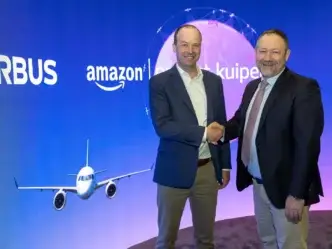


Airbus UpNext has launched its SpaceRAN (Space Radio Access Network) demonstrator, a key initiative to advance standardised 5G Non-Terrestrial Network (NTN) technologies and explore how global connectivity can be extended beyond terrestrial infrastructure into space.
At its core, the SpaceRAN programme is designed to investigate whether satellites can act not just as relays, but as software-defined 5G base stations in orbit, with on-board signal processing that reduces latency, increases throughput, and enables more efficient network operations than traditional bent-pipe architectures.
Why this matters now
Non-Terrestrial Networks: particularly in Low Earth Orbit (LEO), are becoming a central component of connectivity strategies for a range of sectors, including aviation, defence, government, and critical mobility applications. NTN promises coverage that is geographically unbounded, enabling 5G services in remote or airborne environments where terrestrial networks cannot reach.
The SpaceRAN demonstrator will be tested in two phases:
- A ground-based testbed that simulates a dual-satellite LEO constellation to validate key functionality including inter-satellite routing and handovers;
- An in-orbit payload on an Airbus LEO satellite that will act as a 5G NTN base station to connect terrestrial, airborne and satellite endpoints directly via standardised 5G interfaces.
This on-orbit capability is expected to launch around 2027, with in-orbit trials continuing into 2028.
Standardisation and software-defined satellite architecture
Unlike conventional satellites that primarily relay signals, the SpaceRAN demonstrator’s software-defined architecture allows signal processing to occur on-board and be reconfigured from the ground. This approach can improve:
- Latency and throughput
- Network management and routing efficiency
- Interoperability with terrestrial 5G networks
All of which are important prerequisites for global, scalable NTN solutions.
The demonstrator’s emphasis on open standards and interoperability aligns with industry efforts to avoid proprietary fragmentation in non-terrestrial connectivity and to support integration with evolving terrestrial and future 6G ecosystems.
Consortium and collaborative scale
Airbus UpNext is working with a wide consortium of industry players on SpaceRAN, including:
- Aalyria
- AccelerComm Ltd
- CesiumAstro
- Deutsche Telekom
- Eutelsat
- Industrial Technology Research Institute (ITRI)
- Keysight Technologies
- ONATi
- Radisys
- Sener
- ST Engineering iDirect
among others supporting ground and in-orbit demonstration efforts.
Companies such as Keysight Technologies are providing critical test, measurement and emulation tools, including ground-based satellite channel and mobility emulation to validate NTN scenarios that will inform future satellite network performance and standards development.
Implications for connectivity and broader trends
- For commercial aviation, standardised 5G NTN could support onboard connectivity that is more resilient and integrated with ground networks than current solutions.
- For government and defence, NTN infrastructure offers potentially sovereign, secure connectivity beyond the reach of terrestrial systems.
- For the broader telecom ecosystem, successful NTN demonstrations may help lay the groundwork for future 6G capabilities by integrating space and terrestrial networks under common standards.
This convergence of satellite, terrestrial, and sensing-driven networks was also a key theme discussed during our IWSS 2025 (AI x Spectrum x Space x Sensing), where industry, government, and research leaders examined how AI-native networks, NTN, and spectrum intelligence are moving from experimentation toward early operational reality.
What to watch next
- 2027: scheduled launch of SpaceRAN on-orbit payload
- 2028: in-orbit testing and validation of 5G NTN functions
- Ongoing work on 3GPP Release 18/19 NTN specifications that underpin standardised satellite-to-cell integration
The SpaceRAN programme illustrates how satellite and terrestrial network paradigms are converging, and why NTN experimentation is critical as the industry moves toward pervasive, interoperable global connectivity.