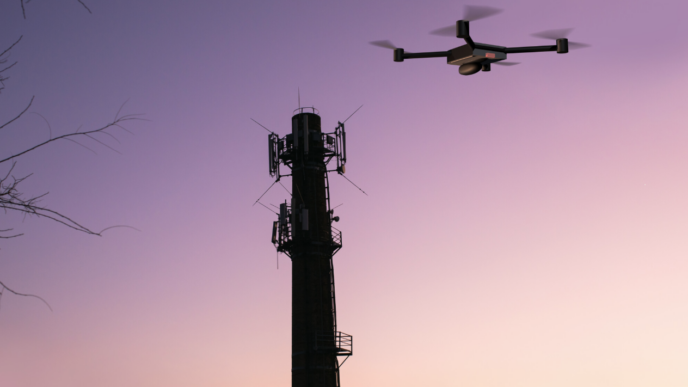




Ericsson has announced a live proof of concept for Integrated Sensing and Communication (ISAC) at its U.S. headquarters in Plano, Texas, centered on drone detection using the company’s massive-MIMO radios. The company says the demonstration shows how 5G infrastructure can sense passive objects in its surroundings while continuing to provide communication capabilities, positioning the network itself as part of a wider situational-awareness layer.
Why it matters:
This is one of the clearer public signals so far that sensing is beginning to move from 6G theory and research language into more concrete network demonstrations. Ericsson is not presenting sensing as a distant concept. It is showing it in the context of airspace awareness, with potential relevance for commercial, public safety, and defense use cases.
The bigger picture:
Ericsson explicitly frames ISAC as a technology that can support drone and airspace safety, transportation assistance, industrial protection, and even improved network performance. That matters because it expands the value proposition of advanced wireless beyond speed, coverage, and latency. If networks can also sense their environment, they start to become part of a broader control and intelligence stack. That is where the conversation around 5G Advanced and early 6G gets more strategically interesting.
Between the lines:
The real significance here is not only drone detection. It is the implication that existing telecom infrastructure, especially advanced radio systems such as massive-MIMO, may evolve into dual-purpose assets that deliver both connectivity and environmental awareness. That could matter in places where operators, governments, industrial players, or defense organizations already have deployed infrastructure and want to extract more value from it without standing up entirely separate sensing systems. The point about extracting broader infrastructure value is an inference, but it follows directly from Ericsson’s framing of wide-area sensing through mobile networks.
Ericsson also leans into a strategic message: that the U.S. is showing leadership in ISAC. That is not a casual framing. It places the demo in a wider race around who defines the next layer of wireless capability, not just who supplies radios. In that sense, ISAC is starting to look less like a niche feature and more like a building block in the future positioning of telecom infrastructure. This interpretation is an inference, but it is consistent with the company’s headline and the way the release is structured.
What to watch:
The key question now is whether ISAC remains a high-profile proof-of-concept category or begins to turn into something operators and infrastructure players can deploy in targeted environments. Drone detection is an obvious early use case because it is easy to understand and highly relevant. But the larger opportunity may be broader: industrial monitoring, transportation corridors, protected facilities, and other scenarios where communications and sensing can reinforce each other. Ericsson’s announcement suggests that this conversation is moving closer to real-world deployment logic, even if it is still early.