


ORAN Development Company’s new funding round is notable not just because of the investors behind it, but because of the technical argument the company is making about where AI-RAN is headed. ODC said it has raised $45 million to expand its Odyssey platform and what it calls a Distributed Compute Grid, turning cell sites into high-performance compute hubs for AI inference, sensing and low-latency applications at the wireless edge.
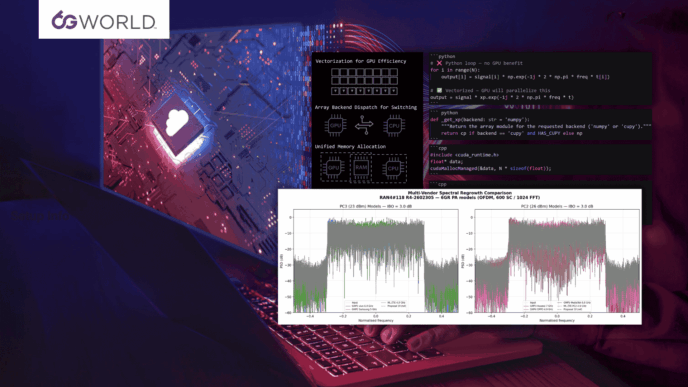
Why it matters: most AI-RAN discussion still centers on automation, orchestration and network optimization. ODC is pushing a more ambitious thesis. In technical materials published this month, the company described RANIQ as a unified edge intelligence platform that runs co-resident on DU/CU compute, exposes real-time signal intelligence across L1-L3 through an SDK, and is designed to make that intelligence available to applications in real time without adding new hardware or disrupting network operations. In practice, that points to a RAN that does more than move traffic, serving as a platform for sensing, inference and new edge-native services.
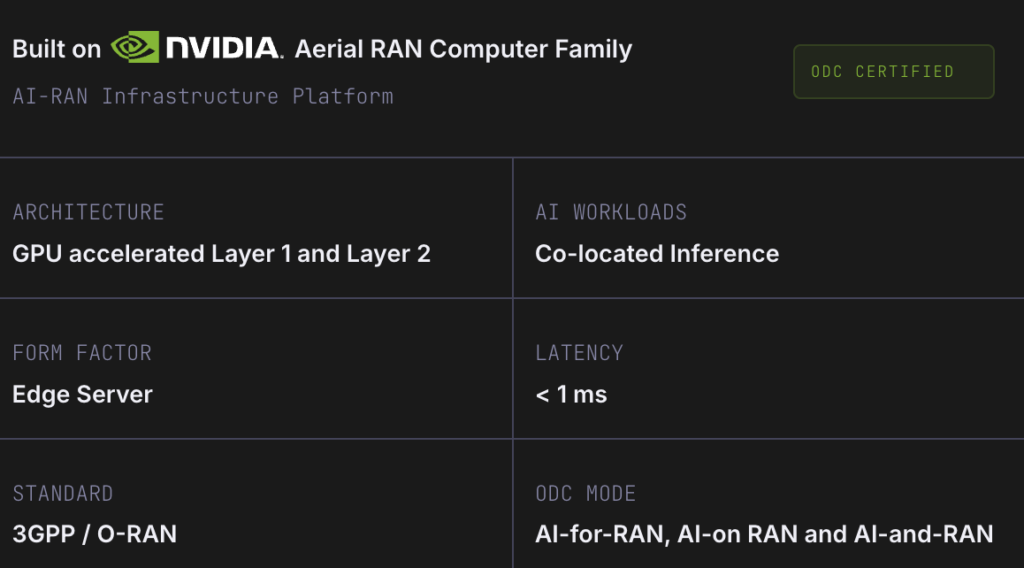
That is an important distinction. ODC is not positioning AI as a management-layer add-on sitting above the network. It is arguing for deeper integration, closer to the signal-processing and software stack itself. If that model proves out, it could expand AI-RAN from an efficiency story into a platform story, where the RAN becomes part of the runtime environment for industrial autonomy, mission-critical applications and real-time physical AI. This last point is an inference based on ODC’s technical description and the use cases cited in its announcement.
The bigger picture: the timing also matters. The funding comes just weeks after the Linux Foundation launched the OCUDU Ecosystem Foundation, a public-private effort to build an open-source CU/DU base for 5G and early 6G, with founding members including AMD, AT&T, DeepSig, Ericsson, Nokia, NVIDIA, SoftBank, SRS and Verizon. ODC joined as a general member. That broader backdrop suggests the market is moving beyond the question of whether AI belongs in the RAN and toward a more strategic one: who controls the software foundation, the intelligence layer and the monetizable applications that sit on top of it. That final sentence is an inference from the OCUDU structure and ODC’s platform positioning.
Between the lines: the investor list may matter as much as the funding total. ODC’s backers combine telecom operators, incumbent infrastructure players, cloud and silicon influence, and a national-security-oriented systems integrator. That mix suggests AI-RAN is increasingly being viewed as part of a wider infrastructure, resilience and sovereignty agenda, not just another telecom roadmap theme. This is an inference based on the syndicate composition and the language used in the company’s announcement.
What to watch: ODC now has to prove that this deeper technical architecture can translate into visible deployments and repeatable operator value. The concept is more ambitious than a standard AI-RAN optimization pitch. The next question is whether the market is ready to buy the RAN not only as connectivity infrastructure, but as a programmable sensing and intelligence layer at the edge. This conclusion is an inference grounded in ODC’s announcement and technical positioning.