

Produced in partnership with Keysight Technologies
The wireless industry likes to describe 6G through its most ambitious ideas.
Sub-THz spectrum. AI-native networks. Integrated sensing and communication. Non-terrestrial networks. Extreme MIMO. Reconfigurable intelligent surfaces. Digital twins. Joint communication and sensing. Ubiquitous connectivity. Resilient dual-use systems. Immersive services. Distributed intelligence.
All of these themes matter. They shape research agendas, standards discussions and long-term investment. But they also point toward a less visible, more practical constraint.
Before 6G can become a network, it has to become hardware.
That hardware will be difficult to build. Not only because the frequencies are higher, but because the design problem itself is changing. The RF front end is no longer a collection of separable components connected through a relatively predictable chain. It is becoming a tightly coupled system where chips, packages, interposers, boards, antennas, thermal behavior and system-level performance interact from the beginning.
This shift matters strategically. It affects semiconductor companies, network equipment vendors, satellite and NTN players, defense integrators, operators, test and measurement firms, EDA providers and the broader wireless supply chain.
The next phase of wireless competition will not be decided only by who has the best waveform, the most spectrum, the strongest AI model or the most advanced RAN software.
It will also be decided by who can master RF hardware complexity.
5G taught the industry a hard lesson about RF reality
5G showed that radio performance is never just a theoretical question.
The industry entered the 5G era with a strong focus on massive MIMO, mmWave, low latency, network slicing, industrial use cases and private networks. Some of those ideas became central to deployment. Others proved harder to commercialize than the early narrative suggested.
The mmWave story is especially instructive.
The technology was real. The bandwidth was real. The peak-rate promise was real. But deployment economics were shaped by physics and hardware constraints: propagation loss, blockage, beam management, site density, device complexity, RF front-end integration, power consumption, thermal behavior and the cost of building networks around higher-frequency coverage.
The lesson was not that mmWave failed. The lesson was that RF hardware and deployment economics ultimately discipline wireless ambition.
6G will face a similar reality, but with even more pressure.
If the industry explores frequencies in the upper mmWave and sub-THz ranges, RF design enters a regime where the physical dimensions of the module become comparable to the wavelength. At that point, design assumptions that worked at lower frequencies become less reliable.
A package transition can no longer be treated as a passive handoff. A bondwire is not simply a connection. A via field is not just layout detail. A board launch can become part of the RF behavior. A bias line can affect the signal environment. An antenna feed is not a separate final-stage problem. Thermal effects are not something to check only near the end.
At these frequencies, the module behaves as a system.
That is the core challenge.
6G moves RF design from components to integrated systems
For decades, much RF and microwave design was organized around component boundaries.
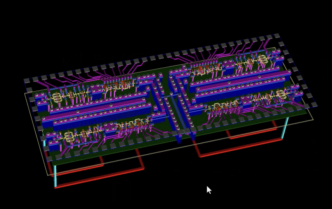
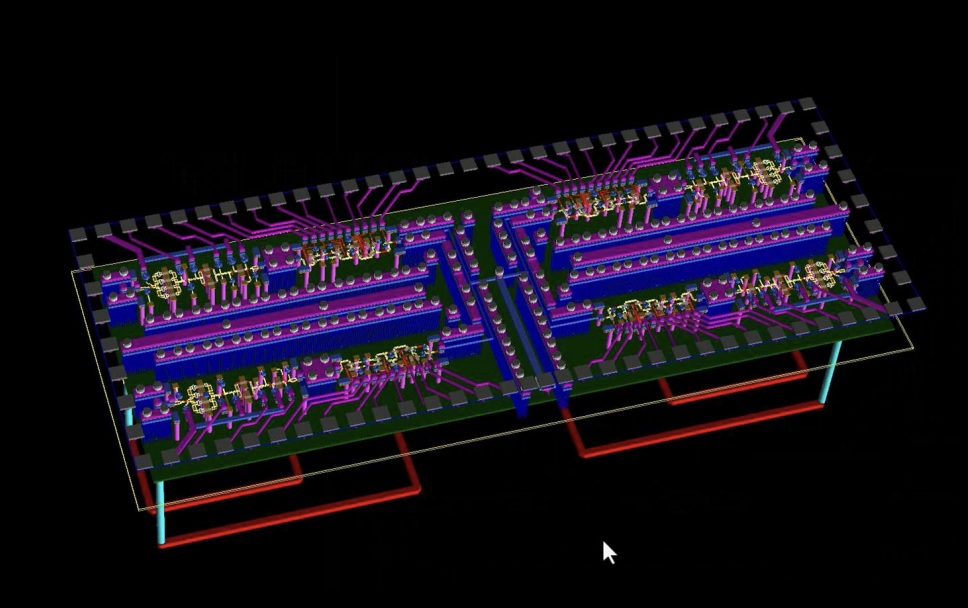
Figure 1. At upper mmWave and sub-THz frequencies, RF modules become tightly coupled physical systems where chip, package, interconnect, board and antenna behavior interact.
The RFIC was designed in one flow. The package was modeled in another. The board was handled somewhere else. Antenna design often lived in its own domain. EM simulation, circuit simulation, thermal analysis and system validation could be performed at different stages by different teams.
That separation matched how companies were structured. It matched how tools evolved. It matched the supply chain. It also worked reasonably well when the interfaces between domains were forgiving enough.
But 5G-Advanced and 6G are pushing the industry toward a different model.
The future RF module may combine silicon RFICs, III-V MMICs, advanced packaging, interposers, high-density interconnects, printed structures, antennas and thermal management into one integrated design space. This is part of the broader movement toward heterogeneous integration and system-in-package approaches that are already reshaping advanced semiconductor design.
In wireless, this shift is not just about miniaturization. It is about making high-frequency systems practical.
Higher frequencies require tighter integration. Phased arrays require many RF paths to behave consistently. Integrated antennas reduce some interface losses but increase design coupling. Advanced packaging can improve performance but also creates new parasitic and thermal challenges. Multi-band systems add more constraints. Manufacturing variation becomes harder to ignore.
The result is that RF module design becomes less like assembling independent blocks and more like solving a multi-domain system problem.
This has major business implications.
For semiconductor companies, differentiation shifts from selling a strong component to enabling a predictable module-level outcome.
For network equipment vendors, RF hardware design becomes part of system architecture, not just an implementation layer.
For operators, RF module performance influences site density, energy consumption, coverage quality, capacity, hardware lifecycle and total cost of ownership.
For defense and dual-use systems, RF module behavior can affect sensing, jamming resilience, spectrum agility, beamforming, detection and survivability.
For satellite and NTN players, RF hardware choices influence terminal economics, link budgets, thermal limits, mobility and service availability.
This is why RF design deserves a more central place in the 6G strategy conversation.
The old design flow is becoming the bottleneck
The traditional design flow was often shaped by the technologies and tools involved.
A GaAs or GaN circuit might sit in one environment. A silicon RFIC might sit in another. The package might be exported and re-imported. The board might be assembled later. The antenna might be simulated separately. System-level checks might happen once the RF chain was already mostly defined.
That model creates handoffs.
Handoffs create friction.
Files are exported. Ports are reconnected. Netlists are checked. Models are translated. Layout changes are manually propagated. Libraries are updated. EM domains are rebuilt. Simulation assumptions are revalidated. Engineers spend time trying to determine whether a problem comes from the design itself or from the workflow used to represent the design.
At lower frequencies, this overhead was often manageable. At 5G-Advanced and 6G frequencies, it becomes dangerous.
The tighter the coupling between domains, the more expensive each manual handoff becomes. A small inconsistency can produce misleading results. A model update can break correlation. A package edit may not be reflected properly in the board or antenna context. A port definition may change the interpretation of an EM result. A thermal assumption may no longer match the operating condition used in the circuit simulation.
The workflow itself becomes a source of engineering risk.
That is why the future of RF design is not only about better individual solvers. It is about integrated workflows that preserve design context across chip, package, board, antenna and system domains.
The competitive advantage is moving from individual tools to the ability to orchestrate the complete design process.
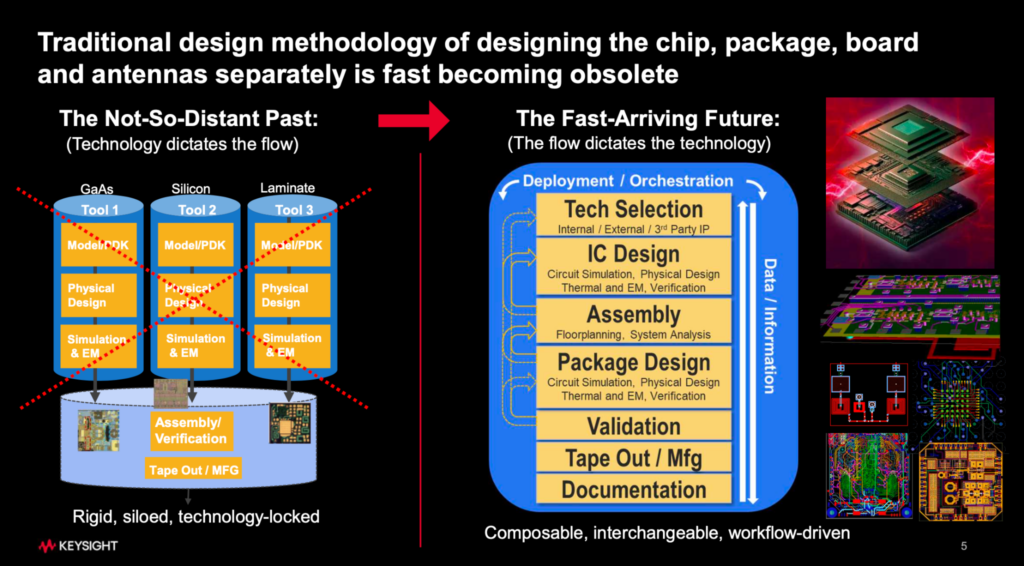
Figure 2. The old RF design model was shaped by technology boundaries. The emerging model is shaped by integrated workflows that preserve design context across technologies.
Why this matters for 6G commercialization
The 6G industry often frames commercialization around standards timelines, spectrum availability, use-case maturity and operator appetite. Those are all important. But hardware readiness deserves equal attention.
A 6G concept can be compelling in a research paper, a simulation environment or a standards presentation. That does not mean it can be produced as reliable, affordable, manufacturable hardware.
This gap matters because wireless products are constrained by timelines.
Network vendors need to hit product windows. Semiconductor companies need to win sockets. Operators need hardware that fits deployment economics. Defense programs need credible demonstrations. Satellite providers need terminals and gateways that match business plans. Device makers need form factors, power envelopes and thermal behavior that consumers can live with.
Late-stage RF problems are expensive.
A respin is not only an engineering inconvenience. It can mean new prototypes, new fixtures, new measurement cycles, delayed customer trials, missed market windows and reduced confidence. In infrastructure, the cost of delay compounds across procurement, field validation and deployment planning. In defense and satellite, delays can affect program timing and strategic positioning.
This is why reducing design turns is not just an engineering productivity metric. It is a business metric.
If integrated workflows can help teams discover problems earlier, explore more design options, reduce manual errors, improve traceability and make the first hardware drop closer to the final product, they directly affect time-to-market and cost.
That is the strategic case for RF workflow transformation.
The real challenge is multi-domain optimization
A future RF module must satisfy many requirements at once.
It may need to meet output power, efficiency, gain, noise, EVM, ACLR, OBUE, phase noise, nonlinear stability, thermal limits, antenna gain, beamforming quality, spectral compliance, manufacturing yield and system-level performance.
Those requirements are not independent.
Improving efficiency can hurt linearity. Reducing size can worsen thermal behavior. Changing a package transition can affect impedance, coupling and radiation. Optimizing an antenna feed can alter the RF chain. A nonlinear amplifier can produce harmonic behavior that affects phased-array radiation. A design that looks good in a narrow circuit simulation may fail once EM, thermal and system-level effects are added.
This is the essence of the 6G RF problem.
The industry is not merely designing higher-frequency components. It is designing coupled systems under multiple constraints.
That makes co-simulation and co-optimization central.
Circuit simulation, electromagnetic simulation, electrothermal analysis and system-level wireless validation need to become part of the same decision loop. The goal is not to ask, “Does this block work?” The goal is to ask, “Does this integrated module satisfy all critical requirements under realistic conditions?”
That difference is important.
In a phased-array system, the RF chain and antenna cannot be separated cleanly. Amplitude and phase variation affect beam behavior. Thermal gradients can create non-uniform performance across elements. Nonlinearities can influence spectral and spatial emissions. Package and board effects can alter element behavior. The system result depends on the complete chain.
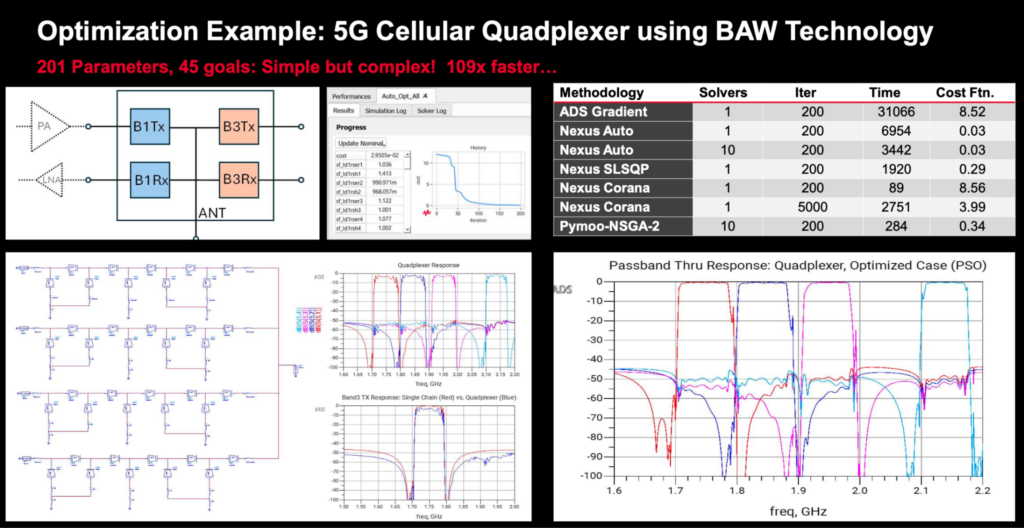
Figure 3. A practical RF optimization problem can involve hundreds of parameters and dozens of goals, making parallel optimization and advanced algorithms increasingly important.
In ISAC, the challenge becomes even broader. A radio that communicates and senses must manage RF impairments, leakage, dynamic range, phase noise, synchronization, clutter, waveform quality and detection performance. Hardware decisions can directly influence whether sensing results remain meaningful.
In NTN, the RF design interacts with link budget, Doppler, mobility, beam tracking, terminal constraints and thermal limits. The system cannot be treated as an abstract communications channel disconnected from hardware reality.
In dual-use and defense, the same module may need to operate in contested, congested or rapidly changing spectrum environments. It may need resilience, agility and predictable behavior under interference or jamming. Again, the RF front end becomes part of the operational capability.
The common thread is clear: advanced wireless use cases collapse the boundary between RF hardware and system design.
Traceability is becoming a strategic engineering capability
Traceability sounds like documentation. In advanced RF design, it is more than that.
When a design crosses multiple technologies, tools, layers and teams, the organization needs to know where the design data came from, which model was used, what changed, who changed it, which simulation result reflects which version, and whether downstream analysis is still consistent with upstream edits.
Without this, engineering teams lose time and confidence.
They may chase false failures caused by workflow errors. They may make decisions based on outdated models. They may miss the impact of a package or board edit. They may struggle to correlate simulation and measurement. They may be unable to explain why a design worked in one environment but failed in another.
At 6G frequencies, that uncertainty is costly.
Traceability supports faster debugging. It reduces manual transfer errors. It helps engineers isolate the source of a problem. It gives technical leaders more confidence in sign-off decisions. It also makes design knowledge easier to reuse across projects.
For business leaders, traceability is a risk-management capability.
A company that cannot trace its design assumptions across chip, package, board, antenna and system domains will struggle to scale complex RF development. A company that can preserve that context has a better chance of reducing respins and improving engineering throughput.
AI will matter most where it captures engineering intent
AI in wireless is often discussed at the network level: energy optimization, traffic prediction, beam management, anomaly detection, service assurance, RAN automation and AI-native air interfaces.
But AI will also reshape how wireless hardware is designed.
The most useful role of AI in RF design is not to replace the engineer. That idea is both unrealistic and strategically misleading. RF design depends on physical intuition, judgment and accountability. Engineers still need to understand impedance, stability, nonlinearity, EM coupling, noise, thermal behavior, yield, measurement correlation and system requirements.
The more realistic role of AI is to capture, orchestrate and accelerate expert workflows.
Capture means turning expert actions into reusable design IP. Many RF design methods live as tacit knowledge: how an experienced engineer sets up a simulation, chooses a matching strategy, defines sweeps, handles EM extraction, interprets instability, checks corners or prepares sign-off. If that knowledge remains trapped in manual behavior, it does not scale.
Python automation, macro recording, workflow graphs and reusable scripts can turn that knowledge into assets.
Orchestration means using automation and copilots to coordinate complex tasks. The value is not a simple prompt that creates a basic filter. The deeper value is the ability to guide simulation setup, run multi-step flows, connect tools, modify designs, evaluate results and keep the engineer focused on decisions rather than tool mechanics.
Acceleration means reducing the time required to explore large design spaces. Parallel solvers, advanced optimization algorithms, surrogate models and reinforcement learning can help teams evaluate options that would be impractical to test manually.
This is where AI becomes strategically useful.
Not as a generic intelligence layer, but as a way to scale engineering methodology.
The RF talent problem is becoming a business risk
Advanced RF and microwave design is a scarce skill set.
It takes years to build practical intuition around nonlinear behavior, EM interactions, high-frequency layout, matching, stability, measurement correlation, device behavior and manufacturability. Many organizations rely heavily on a relatively small number of senior experts. Some of that expertise is deeply tacit. It is embedded in habits, internal methods, old projects, scripts, preferred checks and lessons learned from failures.
That creates a business risk.
As wireless systems become more complex, companies cannot depend only on hiring more senior RF engineers. The talent pool is limited, and the learning curve is steep. At the same time, 5G-Advanced, 6G, NTN, defense, automotive radar, satellite communications and advanced Wi-Fi all compete for related expertise.
The answer is not simply “use AI.”
The answer is to capture design knowledge before it disappears.
Organizations need to turn expert workflows into reusable assets. They need to train younger engineers not only in RF fundamentals, but also in automation, simulation strategy, data traceability and AI-assisted workflows. They need to build libraries of validated methods, not just libraries of components.
This turns workflow into institutional memory.
The companies that do this well will not eliminate the need for senior RF experts. They will make those experts more scalable.
Surrogate modeling changes the economics of design exploration
One of the most practical AI-enabled approaches in RF design is surrogate modeling.
High-fidelity simulations can be slow. EM analysis, large-scale optimization and multi-domain co-simulation can become computationally expensive, especially when teams need to explore many geometries, materials, corners, frequency ranges and operating conditions.
A surrogate model approximates an expensive model with a faster one.
For example, an EM-modeled inductor, matching structure, interconnect or passive network can be represented by a compact model trained from high-fidelity data. If validated carefully, this model can be used to accelerate optimization and design-space exploration.
This matters because future RF modules will have too many variables for traditional manual exploration.
Designers may need to evaluate geometry parameters, process corners, package transitions, antenna feeds, thermal constraints, bias structures, system-level waveform behavior and manufacturing tolerances. If every candidate requires slow full-wave simulation, the design space becomes too expensive to explore.
Surrogate models can help teams move faster.
But there is an important caution. In RF design, speed without trust is dangerous. A surrogate model is only useful if the design team understands its training range, limits and validation status. A fast wrong model can create false confidence and push errors later into the process.
The strategic value of surrogate modeling is therefore not just acceleration. It is controlled acceleration inside an expert-defined workflow.
Measurement and simulation are converging
As RF design becomes more complex, the boundary between simulation and measurement becomes more important.
Simulation is valuable because it lets teams explore designs before hardware exists. Measurement is essential because hardware always reveals what the model missed. The strategic opportunity is to connect the two more tightly.
The future design loop will increasingly look like this:
Design the module. Simulate across domains. Optimize before hardware. Build the prototype. Measure real behavior. Correlate measurement and simulation. Refine the models. Capture the workflow. Reuse the method. Automate more of the process.
This loop matters because 6G hardware will need more predictive confidence before expensive prototypes are built.
It also matters for test and measurement strategy. T&M companies are no longer just providers of instruments at the end of the process. They are becoming part of the continuous design-validation loop, connecting EDA, simulation, emulation, measurement, calibration and system validation.
For telecom and wireless companies, this means procurement and partnership decisions should change. It is not enough to ask which tool can run a simulation or which instrument can make a measurement. The better question is whether the environment helps the organization reduce uncertainty across the whole lifecycle from design to validation to manufacturing.
Operators should care about RF design earlier
It may be tempting to see RF module design as a vendor-side problem. Operators do not design every chip, package or antenna structure. But they are affected by the consequences.
RF hardware maturity shapes deployment economics.
If a radio unit has better efficiency, operators see it in power consumption. If thermal behavior is poor, they see it in reliability, form factor and site constraints. If phased-array behavior is fragile, they see it in coverage and capacity. If hardware is expensive or difficult to manufacture, they see it in network cost. If advanced spectrum bands require dense deployment because practical RF performance falls short, they see it in capex.
Operators should therefore pay attention to RF hardware readiness earlier in the 6G cycle.
This does not mean operators need to become EDA experts. It means they should ask better strategic questions.
Can the vendor model realistic RF impairments early? Can the module be validated across thermal and manufacturing variation? Can phased-array behavior be predicted under practical constraints? Can simulation and measurement be correlated? Can the supplier explain how hardware risk is reduced before prototype and manufacturing? Can the same platform support evolution from 5G-Advanced into 6G?
These questions connect RF design to business risk.
Defense, NTN and sensing will push RF design even harder
The most demanding 6G-adjacent markets may not be ordinary mobile broadband.
Defense, non-terrestrial networks, satellite direct-to-device, sensing-enabled networks, private industrial systems and high-capacity fixed wireless all push RF design in different ways.
Defense systems need resilience, spectrum agility, interference tolerance, beam control and operation in contested environments. NTN systems need link-budget discipline, mobility handling, Doppler tolerance, antenna constraints and thermal reliability. ISAC systems need RF chains that can support communication and sensing requirements simultaneously. Industrial systems need predictable performance, reliability and often long lifecycles.
These markets reward hardware credibility.
A concept that works in a clean simulation but fails under real RF impairments will not survive serious evaluation. A module that cannot be manufactured reliably will not scale. A phased-array system that cannot maintain predictable behavior under thermal, nonlinear and environmental effects will not meet operational expectations.
This is why multi-domain design workflows will matter beyond telecom infrastructure. They will shape the broader advanced wireless ecosystem.
The strategic shift: from design tools to design operating systems
The industry should think differently about RF design environments.
Historically, the question was often: which tool is best for circuit simulation, EM simulation, layout, thermal analysis or system modeling?
That question still matters, but it is no longer enough.
The more important question is whether the organization has a design operating system for complex RF hardware.
A design operating system connects technologies, models, workflows, automation, traceability, simulation, optimization, measurement and human expertise. It allows teams to move from isolated tasks to repeatable methods. It turns senior engineering practice into reusable IP. It reduces manual friction. It gives management better visibility into design risk.
This is the mindset shift.
In 6G, the workflow is not overhead. The workflow is part of the product strategy.
What leadership teams should ask now
Companies preparing for 5G-Advanced and 6G should begin asking practical questions.
- Do we still design RF blocks, packages, boards and antennas as mostly separate activities?
- Where do manual file transfers, imports, exports and model translations create risk?
- Can we trace design changes across chip, package, board and antenna domains?
- Do our simulations include the right combination of circuit, EM, electrothermal and system behavior?
- Where do senior engineers repeat manual workflows that should be captured as reusable IP?
- Are our AI efforts connected to real engineering workflows, or are they limited to generic productivity experiments?
- Can we build trusted surrogate models for expensive simulation tasks?
- Can we correlate simulation and measurement in a way that improves future design cycles?
- Are we training RF engineers to work with automation, Python-based workflows and AI-assisted design environments?
- Can our design process reduce respins, shorten prototype cycles and improve first-pass confidence?
These questions are not only technical. They are strategic.
Conclusion: 6G will expose the companies that cannot manage RF complexity
6G will not be built only in standards meetings, research labs or AI strategy decks.
It will be built in the difficult engineering space where chips, packages, interconnects, boards, antennas, thermal behavior and system performance meet.
That is where many elegant wireless ideas will either become deployable products or remain aspirational concepts.
The industry’s next challenge is not only to invent new wireless capabilities. It is to create the design workflows that make those capabilities manufacturable, measurable and economically viable.
5G-Advanced is already pushing in this direction. 6G will accelerate it.
The companies that treat RF workflow transformation as a strategic priority will move faster, reduce risk and preserve scarce engineering knowledge. The companies that keep relying on siloed design methods, manual handoffs and late-stage validation will struggle as complexity rises.
The hidden 6G bottleneck is not only spectrum.
It is the ability to turn complex RF hardware into reliable products.
That makes RF design workflow one of the most important strategic battlegrounds of the 6G era.
If you are interested in this topic, join the upcoming live sessions:
- New RF and Microwave design workflows for 5G-Advanced/6G with AI automation
- June 17: Europe, 11:00 AM CET
- June 17: Americas, 10:00 AM Pacific
- June 18: Asia, 11:00 AM Seoul / 10:00 AM Beijing
- The session will explore chip-to-antenna co-design, multi-domain RF workflows, traceability, AI-assisted automation, Python-enabled design capture, surrogate modeling and RF workflow acceleration.