


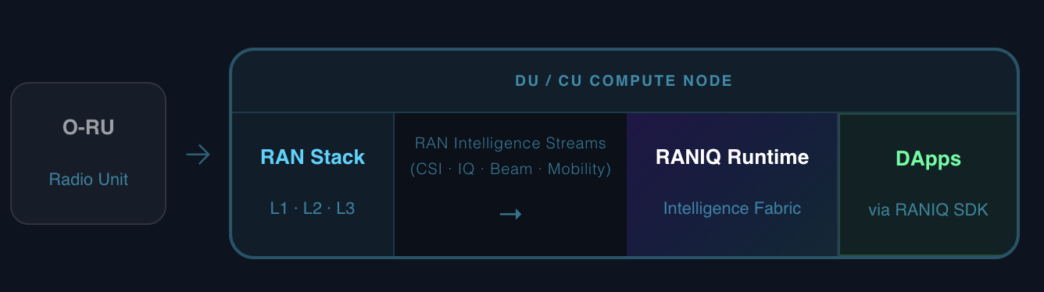
ODC said RANIQ is now generally available on its AI-native RAN stack. The company describes it as a platform that can turn deployed base stations into programmable RF sensor nodes and real-time AI inference engines, with workload isolation on the DU/CU node so live RAN processing is not affected. ODC also says the platform is built on NVIDIA AI Aerial.
Why it matters:
This is not the usual AI-RAN pitch about optimization, automation or dashboards. ODC’s claim is more ambitious: that valuable AI-RAN applications will need access to signal-level intelligence at the point of generation, not just aggregated telemetry exposed upstream through management systems.
The technical angle:
ODC says RANIQ is co-resident with its own L1/L2/L3 RAN stack on the same DU/CU compute node, where it can expose controlled streams of CSI, IQ-derived data, beam metrics, interference signatures, HARQ and mobility events through a runtime and SDK. The company is explicit that RANIQ is not middleware and not a management-layer analytics tool. Its argument is that O-RAN xApps, RIC-based applications and SMO analytics are useful for network management, but not for applications that need sub-millisecond or signal-level access.
What that means:
If ODC is right, the next wave of AI-RAN value may not come only from better network automation. It may come from turning the RAN into a programmable sensing and inference platform for use cases such as interference classification, anti-jamming, RF sensing, predictive handover and other real-time edge workloads. Those use cases are still ODC’s own framing, but the architectural shift is the real story.
The bigger picture:
The timing matters. The Linux Foundation’s OCUDU Ecosystem Foundation, launched at MWC 2026, is focused on building a production-ready open-source CU/DU stack, along with reference architectures, conformance tooling and deployment blueprints to scale Open RAN from pilots to production. That makes RANIQ notable because it points to a different layer of competition: not the shared software base, but the higher-value runtime and intelligence layer above it. The second point is an inference based on the public positioning of both efforts.
Between the lines:
The contrast with the broader market is sharp. Ericsson’s public AI-RAN automation story centers on Non-RT RIC, rApps and orchestration inside its Intelligent Automation Platform, while Nokia emphasizes hardware-agnostic Cloud AI-RAN running across GPU, ARM and x86 with open interfaces and multi-vendor ecosystem support. ODC is pushing a deeper claim: that some of the most strategic AI-RAN value will sit closer to the radio stack itself. That last sentence is an inference from the cited product positioning.
What to watch:
Three questions now matter. First, whether RANIQ becomes a real platform layer or remains primarily a differentiator for ODC’s own stack. Second, whether operators are willing to treat RF intelligence as a new service and monetization layer, not just an internal network asset. Third, whether the most valuable AI-RAN applications ultimately sit below the classic management layer. The first two questions are grounded in ODC’s architecture and operator value claims; the third is an inference.